The Instruction of Amenemope: Full Text in 30 Chapters
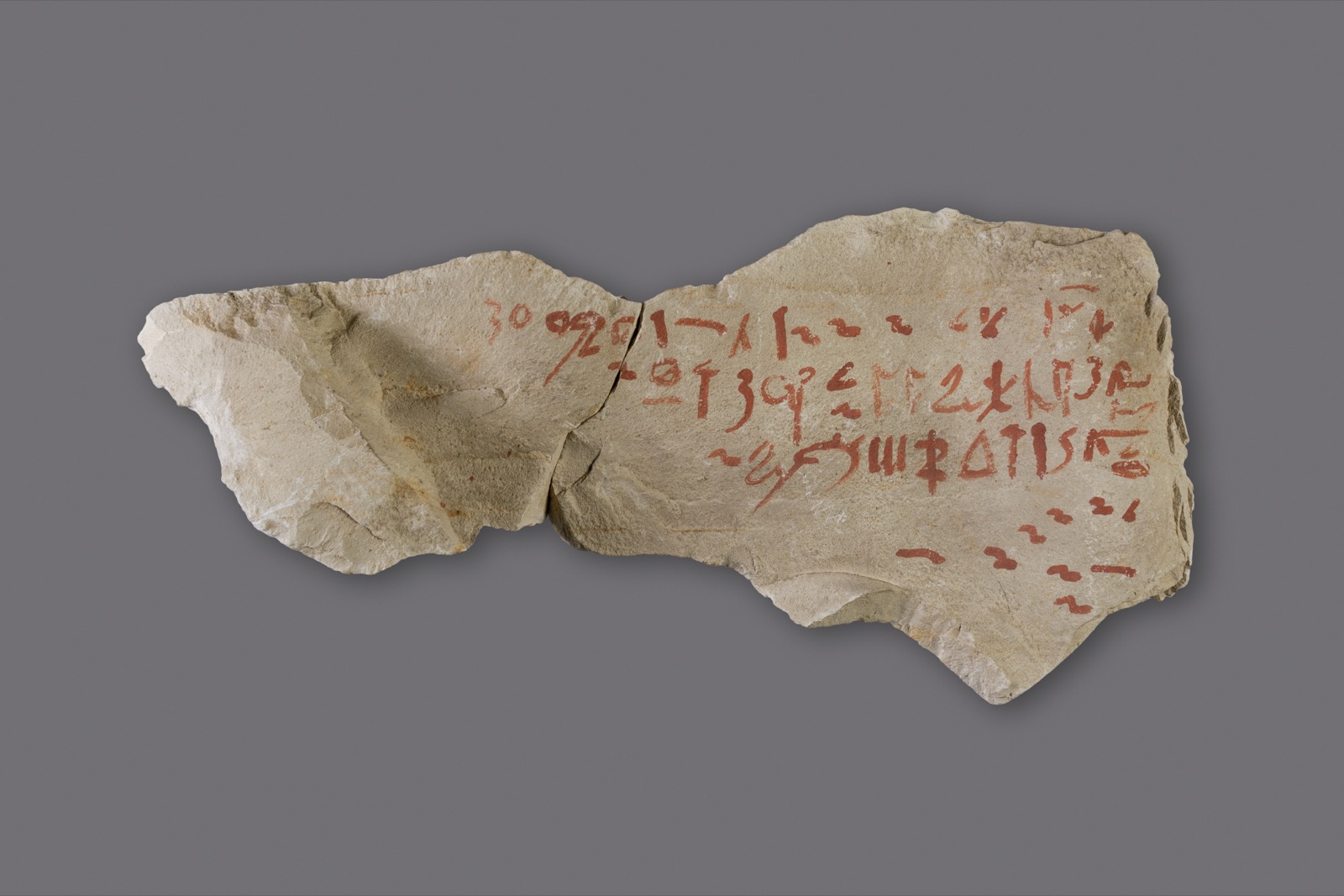
This article was written in Arabic; the text below is an English rendering of the author's Egyptian Arabic translation of the ancient text.
Chapter 1: The Counsel to His Son
Listen well, and open your ears to the words,
and let your heart understand them.
It is good to place these words in your heart,
but woe to the one who neglects them!
Let them rest in the chest of your belly,
and be locked in inside your heart.
When a whirlwind of words arises,
these words will be the mooring post of your tongue.
If you live your life with these words in your heart,
you will find it a successful life.
You will find my words a storehouse for life,
and your body will be well on the earth.
Chapter 2: Do Not Steal
Beware of robbing a poor man,
and of attacking a helpless one.
Do not stretch out your hand to an old man,
and do not snatch words from a great man.
Do not let anyone send you on an evil errand,
and do not befriend the one who does such things.
Do not shout at the one who attacks you,
and do not answer him yourself.
The one who does evil, the shore rejects him,
and the water carries him far away.
The north wind comes down to end his hour,
and mingles with the storm,
the cloud rises,
and the crocodiles turn fierce.
O you full of anger, how do you fare now?
He cries out, and his voice reaches the sky,
and the moon is the one who announces his crime.
Steer the boat so that we can ferry the wicked man across,
without becoming like him.
Lift him up and give him your hand,
and hand him over into the hand of the god.
Fill his belly from your own bread,
so that he is full and can see.
And there is one more thing the god loves in the heart:
that you wait before you speak.
Chapter 3: Wisdom in Speech
Do not start a quarrel with a hot-tongued man,
and do not wound him with words.
Wait before answering the intruder,
and bow before the one who attacks you,
and sleep on the words
before you say them.
The storm that blazes up
like fire in straw,
that is the angry man
in the hour of his anger.
Keep away from him,
and leave him alone.
The god knows how to answer him.
And if you live by these words in your heart,
your children too will walk by them.
Chapter 4: Two Kinds of People
The angry man in the temple
is like a tree growing inside a house.
Its growth does not last,
and in the end it is cut down
and thrown into the storehouse,
or carried away from its place,
and fire becomes its shroud.
But the quiet man,
who keeps away from trouble,
is like a tree in a meadow.
It puts out leaves and its fruit grows large,
and it stands before its lord.
Its fruit is sweet,
and its shade is pleasant,
and its end will be in paradise.
Chapter 5: Honest and Quiet Service
Do not alter the temple's portions.
Do not be greedy, and then you will gain.
Do not remove a servant of the god
in order to honor someone else.
Do not say:
“Today is like tomorrow.”
What will the end be?
When tomorrow comes
today has vanished.
The deep has become the water's edge,
and the crocodiles have appeared,
and the hippopotamus is cornered,
and the fish have gathered,
and the jackals are full,
and the birds are feeding,
and the fishing nets are emptied.
But the quiet ones in the temple
say:
“Great is the blessing of Re.”
Hold fast to the quiet ones,
and you will find life,
and your existence will flourish on earth.
Chapter 6: Do Not Steal Land
Do not alter the boundary
markers of the land.
And do not shift the measuring cord.
Do not covet a cubit of land,
nor encroach on the boundary of a widow.
The line that time has trodden down,
the one who hides it in the ground,
and when he holds it by a false oath,
the moon will seize him with its power.
Know the one who does this on earth.
He is an oppressor of the weak,
and an enemy who destroys your body.
Murder is in his eye,
and his house is an enemy to the city.
His storehouses will be torn down,
and his wealth will be drawn away
from his children's hands,
and given to another.
Beware of tampering with the boundaries of the land,
lest terror carry you off.
A person pleases the god
when he knows the boundaries of the land.
Keep yourself upright,
and fear the Lord of All.
Do not erase anyone's land line,
it is better to leave it as it is.
Cultivate your own land,
and you will find what you need.
And you will get bread
from your own threshing floor.
Better for you one measure from the god
than five thousand gained by injustice.
Injustice does not stay a day
in the storehouse.
Better poverty in the hand of the god
than wealth in the storehouse.
And better bread with a contented heart
than riches with worry.
Chapter 7: Do Not Chase After Riches
Do not let your heart cling to money.
No one escapes
fate and destiny.
Do not let your heart go to waste,
every person has his hour.
Do not wear yourself out
to increase wealth.
What you have is enough for you.
If wealth comes through theft,
it will not spend a night with you.
Morning dawns
and you will not find it in your house.
Its place can be seen
but it has vanished.
The earth opened its mouth
and swallowed it.
Or it made itself two wings
and flew off to the sky.
Do not rejoice in stolen money,
and do not complain of poverty.
The greedy man's boat
sticks in the mud,
but the boat of the calm man
sails with the wind.
Pray to the Aten
when he rises,
and say:
“Grant me health and peace.”
And then
he will give you what you need in your life,
and you will be safe from fear.
Chapter 8: Do Not Speak Evil
Put your goodness in people's hearts,
and then everyone will welcome you.
People welcome the uraeus serpent,
but spit on the serpent Apophis.
Guard your tongue from harmful speech,
and then people will love you.
You will find your place in the temple,
and you will share in the offering bread.
And when they honor you
and the day comes
and the coffin hides you,
you will be safe
from the power of the god.
Do not accuse a man of a crime
when the reason for his flight is hidden.
Whether you hear good or bad,
say it far
from people's ears.
Keep sweet words
on your tongue,
and hide the bad
in your belly.
Chapter 9: Keep Away from the Angry Man
Do not befriend the angry man,
and do not approach him to talk with him.
Do not let your tongue answer one above you,
and take care not to insult him.
Do not let his words cast a rope over you to catch you,
and do not let your answer run on without reckoning.
Speak with someone your own size,
beware of rashness in speech
for words come out fast from an angry man
like the storm before the rain
A person builds and destroys with his tongue
and may say harsh words in a moment of anger
His answer deserves a beating,
because its weight is harm.
He carries a load like the whole world,
but his whole load is lies.
He passes along words that bring people down,
going back and forth with quarrels.
When he eats and drinks inside,
his answer is heard outside.
The day he is called to account for his crime
will be a day of ill omen for his family.
If only Khnum would come to him,
the potter, to the hot-tongued man,
and knead his character.
He is like a young wolf in the pen,
setting one eye against another.
He makes brothers quarrel.
He runs with every wind like a cloud,
and puts out the light of the sun.
He twists his tail like a baby crocodile,
and curls up on himself.
His lips are sweet,
but his tongue is bitter.
A fire is burning in his belly.
Do not leap to be like him,
lest terror carry you off.
Chapter 10: Speak Without Doing Harm
Do not force yourself to greet the angry man,
so that you do not hurt your own heart.
Do not say “peace be upon you” falsely,
while your heart is full of fear.
Do not tell anyone a lie,
the god hates it.
Do not separate your heart from your tongue,
so that all your endeavors succeed.
Then people will respect you,
and you will be safe in the hand of the god.
The god hates the one who falsifies speech,
and loathes the one whose heart is full of quarrel.
Chapter 11: Do Not Wrong the Poor
Do not covet a poor man's property,
and do not crave his bread.
A poor man's money
is like a morsel stuck in the throat,
making the gullet bring it back up.
The one who gains by a false oath,
his belly misleads his heart.
Wherever there is cheating,
success is weak,
and evil spoils the good.
You will be guilty before your superior,
and your words will be muddled.
Your prayer will be returned to you as a curse,
and your prostration returned with a beating.
The big morsel you swallowed
you will vomit up,
and you will lose your gain.
Look at the one in charge of the poor
when the stick reaches him.
All his people are bound in chains,
and he is led to death.
And if you come undone before your superior,
you will be hated by those beneath you.
Keep away from the poor man on the road,
and look at him well
and stay far from his property.
Chapter 12: Always Be Honest
Do not covet the wealth of a great man,
and do not take a big morsel.
If he has you manage his estate,
stay away from his money,
and then your own money will flourish.
Do not snatch at words
with an angry man,
and do not befriend an enemy.
If you are sent to carry straw,
stay away from his granary.
The one who is seen doing crooked work
is not sent again.
Chapter 13: Do Not Write Lies
Do not cheat anyone with your pen on paper,
the god hates that.
Do not give false testimony
to get rid of someone with your tongue.
Do not hold to account a man who has nothing,
and thereby falsify your pen.
If you find a large debt
against a poor man,
divide it into three parts:
forgive two,
and leave just one.
You will find this a path to life.
After you sleep
and wake in the morning,
you will find it good news.
Better praise through people's love
than wealth in storehouses.
And better bread with a happy heart
than riches with worry.
Chapter 14: Be Generous and Respectful
Do not force yourself on anyone,
and do not tire yourself out begging at his hand.
If he says to you:
“This is a gift,”
no poor man refuses it.
Do not blink your eyes at him,
nor lower your head,
nor look away from him.
Greet him with your tongue
and say: “Peace.”
Then he will calm down
and you will succeed.
Do not turn him away when he comes near,
for perhaps another time he will not be there.
Chapter 15: Do Not Cheat with Your Pen
Do good
and you will flourish.
Do not dip your pen
to harm anyone.
The scribe's finger
is like the beak of the ibis,
take care not to falsify with it.
The baboon lives in the house of Khmun (Hermopolis),
and his eye sees the Two Lands.
If he sees someone cheating with his hand,
he carries off his livelihood with the flood.
The scribe who cheats with his hand,
his son will not be entered in the registers.
And if you live by these words in your heart,
your children will walk by them.
Chapter 16: Do Not Cheat the Scales
Do not play with the scale,
and do not change the weights.
And do not shave down the quantities.
Do not covet the measure of the land,
and forget the measure of the treasury.
The baboon sits beside the scale,
and his heart is with the pan.
Where is a god greater than Thoth,
who invented these things?
Do not make short weights,
for they are full of sorrow by the power of the god.
If you see someone cheating,
keep away from him.
Do not covet copper,
and renounce fine linen.
What good is the one who dresses well
if he cheats before the god?
Faience that looks like gold
turns to lead by morning.
Chapter 17: Do Not Cheat the Measure
Beware of falsifying the measure,
so that you do not alter its parts.
Do not make it too much,
and do not make it too little.
Measure it by the right volume,
and let your hand level it precisely.
Do not make the measure double its size,
so that you do not go to the flood.
The measure is the eye of Re,
and he hates the one who shorts it.
The one who measures with cheating,
the eye bears witness against him.
Do not take the farmer's due
and then wrong him in the measuring.
Do not conspire with the one who measures
to steal the household's share.
The power of the threshing floor
is stronger than an oath before the throne.
Chapter 18: Do Not Worry Too Much
Do not lie awake at night afraid of tomorrow,
saying: “What will tomorrow bring?”
A person does not know tomorrow.
The god is always perfect,
and the person is always imperfect.
People's words are one thing,
and the god's deed another.
Do not say:
“I have done no wrong,”
and then go looking for a quarrel.
Wrong belongs to the god,
and he is the one who judges it.
There is no perfection before the god,
but there is shortcoming.
If someone tries to be perfect,
in a moment he ruins his perfection.
Steady your mind,
and keep your heart steady.
Do not steer with your tongue.
A man's tongue
is like the rudder of a boat,
but the Lord of All
is the one who steers it.
Chapter 19: Do Not Swear Falsely
Do not go to court before an official
to falsify your speech.
Do not hesitate in your replies
when the witnesses speak.
Do not swear falsely in the name of your god.
Tell the truth before the official,
so that he does not hold on to you.
And if you come to him another day,
he will lean toward your words,
and he will tell it to the Council of Thirty,
and it will remain known.
Chapter 20: Be Just in Judgment
Do not dress falsehood up as truth in court
to get rid of the one who is in the right.
Do not lean toward fine clothes
and reject the one whose clothes are torn.
Do not take a gift from the strong
and wrong the weak for his sake.
Maat is a great gift from the god,
he gives it to whomever he wishes.
The strength of the one who resembles her
saves the poor man from his oppressor.
Do not make forged documents,
for they are a deadly danger.
And do not change the oracle in the records,
so that you do not upset the god's plans.
Chapter 21: Say Little
Do not say:
“Get me a powerful official, someone in the town has wronged me.”
And do not say:
“Get me a protector, someone who hates me has harmed me.”
You do not know the god's plans,
and it is no use to weep over tomorrow.
Stay in the god's embrace,
and your silence is what will defeat them.
The crocodile that makes no sound,
its dread is ancient and known.
Do not pour out what is in your heart to everyone,
so that you do not lose your dignity.
Do not spread your words to everyone,
and do not befriend a man whose heart is open to all.
Better
the one whose words stay in his belly
than the one who says them to harm another.
A person does not run to be perfect,
nor create perfection in order to ruin it.
Chapter 22: Do Not Provoke Your Enemy
Do not provoke your opponent
so that he brings out what is in his heart.
Do not run at him
if you do not see his deeds.
Understand from his first reply,
and then be silent and you will succeed.
Let him empty what is in his heart,
and know how to wait,
and then he will be exposed.
Grasp his feet
but do not harm him.
Watch him
and do not ignore him.
You do not know the god's plans,
and it is no use to weep over tomorrow.
Stay in the god's embrace,
and your silence is what will defeat them.
Chapter 23: Table Manners
Do not eat bread
before a great official
and gape at him.
If you are full,
make it look as if you are still eating,
and be content with your spittle.
Look at the dish in front of you,
and let it be enough for you.
The official is great in his post,
like a well
rich in water.
Chapter 24: Be Careful
Do not listen to an official's reply inside the house
in order to tell it to someone outside.
Do not let your words go outside,
so that your heart is not pained.
The human heart is a gift from the god,
take care not to neglect it.
As for the one who stands beside the official,
it is better that his name not be known.
Chapter 25: Respect the Will of the God
Do not laugh at a blind man,
nor mock a dwarf,
nor trouble a lame man.
Do not laugh at someone
in the hand of the god,
nor be angry with him over his weakness.
A human being is clay and straw,
and the god is the one who built him.
He tears down and builds every day.
By his will he makes a thousand poor,
and by his will he makes a thousand chiefs.
Happy is the one who reaches the West
safe in the hand of the god.
Chapter 26: Respect Your Elders
Do not sit in the beer house
to be with someone older than you.
Whether a young man great in rank
or one great in years.
Befriend the one your own size,
and Re helps from afar.
If you see someone older than you on the road,
walk behind him respectfully.
Help the elder who has drunk beer,
and respect him like his own children.
The hand is not hurt when it is bared,
and the back is not broken when it bends.
A person loses nothing by kind words,
and gains nothing if his words are empty.
The one who steers the boat
and sees from afar
will not sink it.
Chapter 27: Do Not Insult an Elder
Do not insult someone older than you,
because he saw Re before you.
Do not let him complain of you to the Aten
when he rises, saying:
“A young man insulted an old man.”
This is very painful before Re.
If he strikes you
while your hand is on your chest,
or curses you
while you stay silent,
if you come to him the next day,
he will give you plenty of food.
The dog eats from its master
and he is the one who feeds it.
Chapter 28: Be Generous to the Poor
Do not seize a widow
if you find her in the field,
and then be vexed with her when she answers back.
Do not refuse a jar of oil
to the stranger.
Double it before your brothers.
The god loves the one who honors the poor
more than the one who worships the rich.
Chapter 29: Cross the River Honestly
Do not stop people
from crossing the river
if you are ferrying by boat.
If you are handed an oar
in the middle of the water,
take it in your hands.
It is no crime before the god
if the ferryman does not welcome you.
Do not pretend to be ferrying people
and then demand the fare.
Take the fare from the rich,
and let the poor man cross.
Conclusion – Chapter 30
Look at these thirty chapters.
They teach and refine,
and they are the greatest of books.
They make the ignorant wise.
If they are read to the ignorant,
he is purified by them.
Fill yourself with them,
and put them in your heart.
And build yourself up
as a man who interprets them
and explains them like a teacher.
The scribe skilled at his work
deserves
to be a man at court.