Ancient Egyptian Harper's Songs: Full Texts and Translations
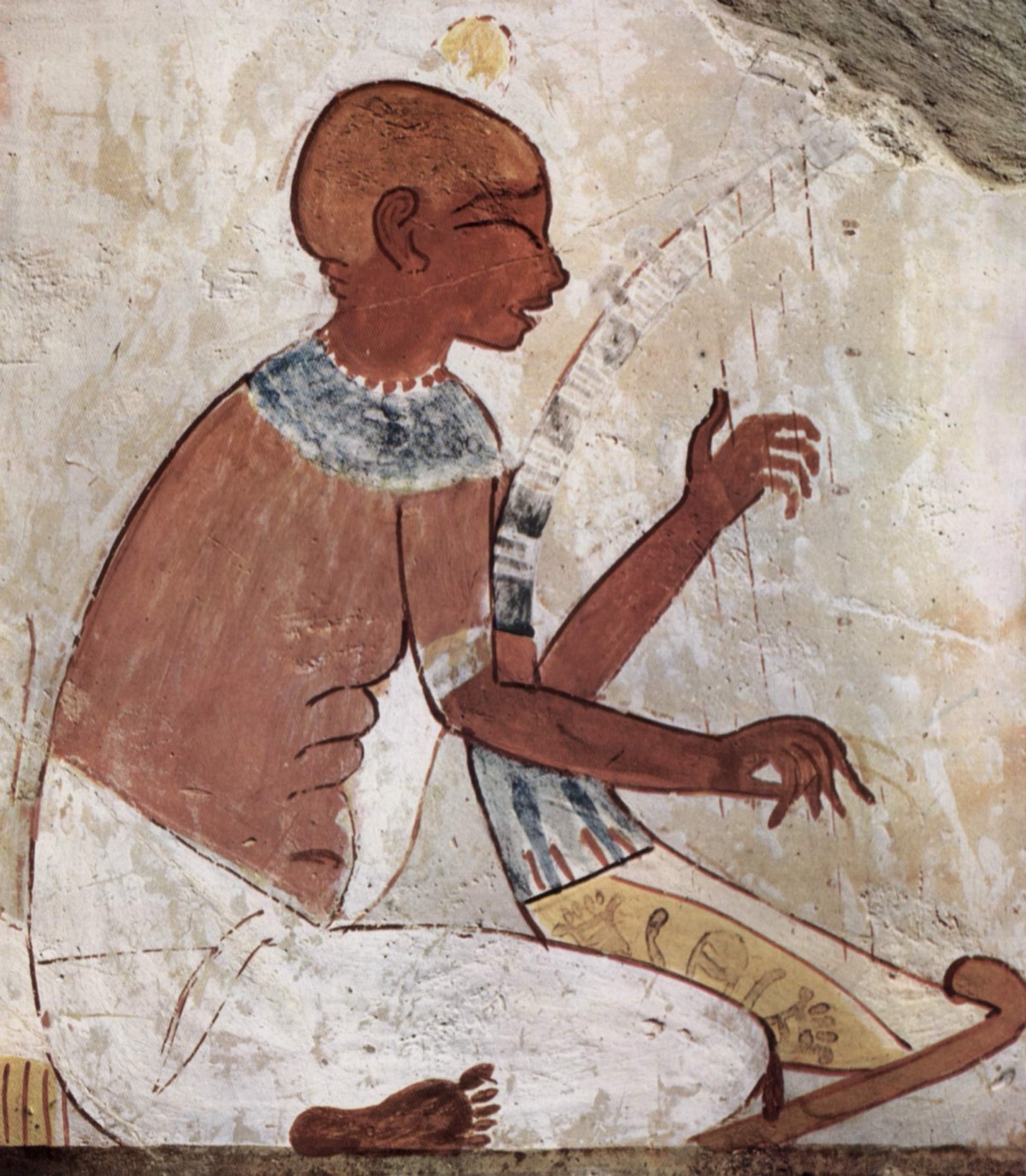
This article was written in Arabic; the text below is an English rendering of the author's Egyptian Arabic translation of the ancient text.
The song "The sky is open for you" (wn n=k pt) and the song "Here lies a happy prince".
The Song "The Sky Is Open for You"
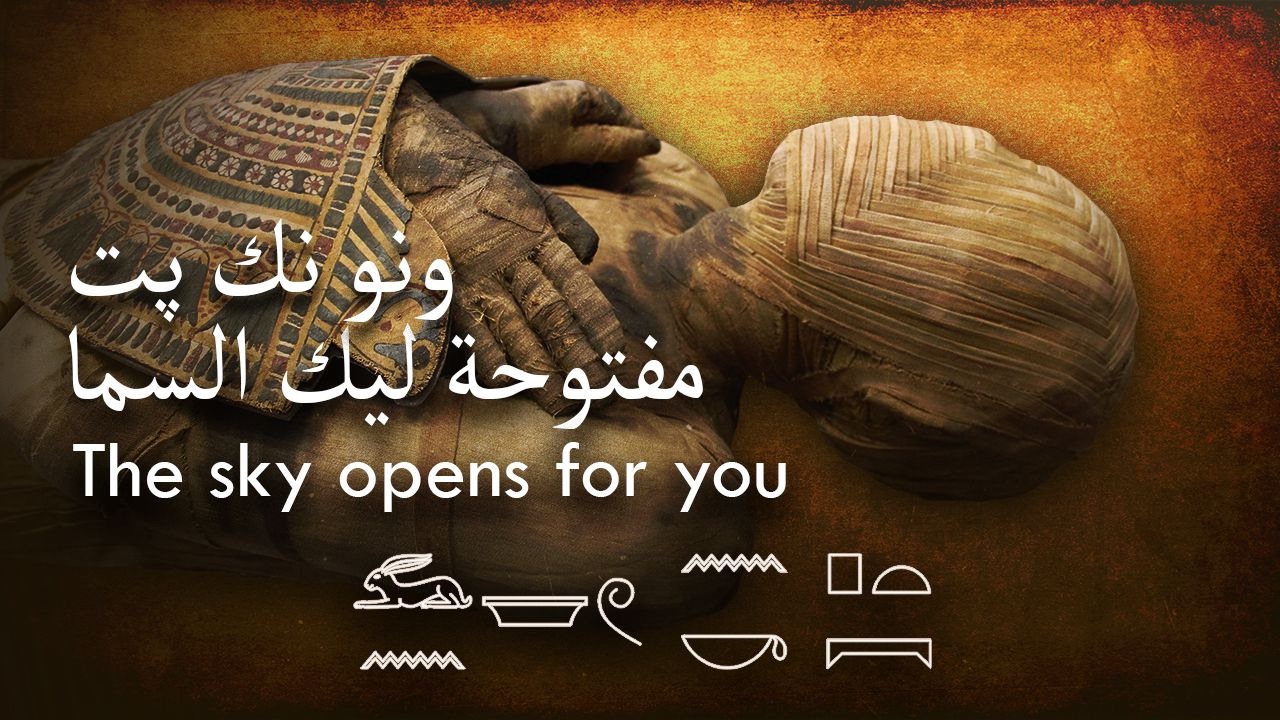
Translation
The sky is open for you,
the earth is open for you.
The good road to the tomb is open for you.
You go in and you come out like the sun,
you advance without obstacles, like the lords of eternity.
The ancient Egyptian text in Arabic letters
ونو نك بت (wn n=k pt)
ونو نك تا
ونو نفر إم غرت-نثر
حقاك برك
مإ رع
وستن نبو مإ نحَح
The text in hieroglyphs (the lyrics)
𓃹𓈖𓉿𓏲 𓈖𓎡 𓇿
𓃹𓈖𓉿𓏲 𓈖𓎡 𓄤 𓅓 𓊻𓏏𓈉
𓅧𓈎𓂻𓎡 𓉐𓂋𓂻𓎡 𓏇𓇋 𓂋𓂝𓇳
𓅱𓋴𓍿𓈖𓂻𓎡 𓎟𓏪 𓏇𓇋 𓎛𓇳𓎛𓀭
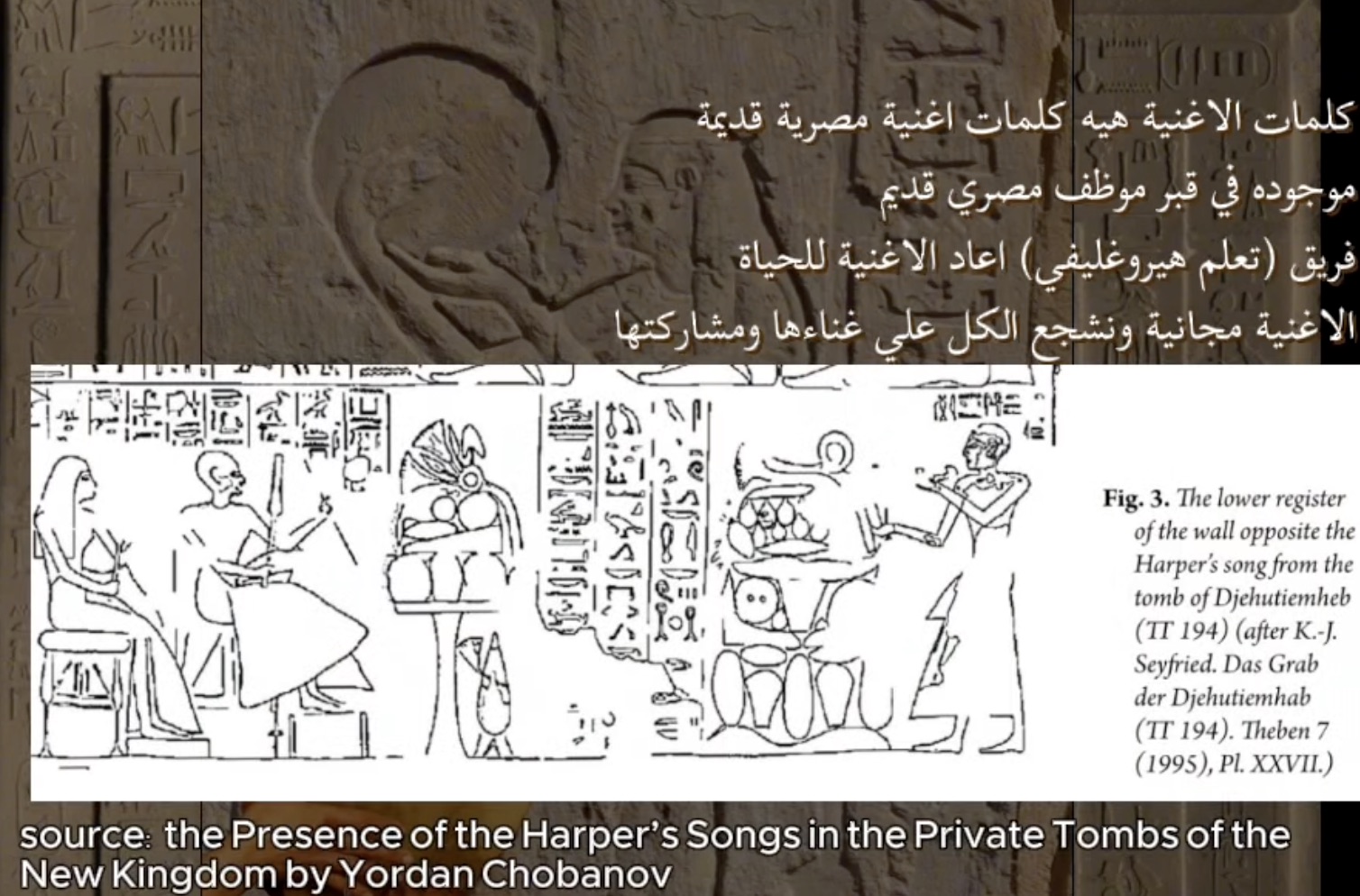
The Bastet team (Learn Hieroglyphs) has brought the song back to life on YouTube, freely available to everyone.
The Song "Here Lies a Happy Prince" (the Harper's Song of Intef)
The song, translated into Egyptian Arabic and rendered here in English:
Here lies a happy prince,
for death is the kindest of fates.
A generation passes, and a generation remains,
and since the days of our oldest ancestors
the world has gone on this way.
Those who were once called gods
now lie in their tombs,
with the nobles
and with those who built tombs for themselves.
Their palaces have vanished.
What, I wonder, has become of them?
Where are the words of Imhotep and Hordjedef,
whose wisdom is still spoken in full?
Where are their palaces?
Their walls have fallen into ruin,
their halls have disappeared,
as though they had never been.
And no one comes back from that world
to tell us how they fare,
or to calm our fear.
We remain in the dark
until we go to join them.
So
rejoice with contented hearts.
It is better for a man to forget;
forgetting is sometimes happiness.
Pamper your heart as long as you live.
Put perfume in your hair,
wear the finest linen you own,
and anoint yourself with the costliest scents,
fit for a god.
Gather your good things here on earth.
Keep your heart light,
do not let it drown in sorrow.
Pamper your heart
and keep joy in it.
Do in this world
whatever your heart desires.
What will grief accomplish?
Osiris, the Weary-hearted,
does not hear tears.
Weeping and wailing
keep no one from the grave.
So
make every day a feast,
and never tire of seeking joy.
For no one
can take his belongings with him,
and the one who departs
does not return again.
The Harper's Song: Tomb of Iki
O tomb,
you have been made ready for a feast,
and your foundations are set upon joy!
The harper Neferhotep,
son of Henu.
The Harper's Song: Tomb of Neferhotep
I heard songs written
on the walls of ancient tombs,
glorifying life on earth
and belittling the other world...
But why should we blame the kingdom of eternity,
just and fair,
where there is no fear?
Death hates violence:
no one there
raises a weapon against his brother.
And no one rebels
in that peaceful kingdom.
All our ancestors lie there
since the first days of mankind;
and the multitudes gather there, all of them,
one after another,
for no one
stays long in the land of Egypt.
And there is no human being
who will not cross to the other side.
Life on earth
is no more than the length of a dream,
but a fine welcome
awaits
the one who reaches the West.
The Harper's Song: Tomb of Nebankh
The singer Tjeniaa says:
Now you are seated in safety
in eternity,
in your everlasting monument!
Your tomb is full
of food offerings,
complete with everything that suits you.
Your soul is with you
and will never leave you,
O treasurer of the king
and seal-bearer, Nebankh!
And the sweet north wind
has become your breath!
So speaks the venerable singer Tjeniaa,
whom he loved
and who keeps his name alive
when she sings to his soul
every day.
The Song "Dialogue of a Man with His Ba"
Death stands before me today:
like the healing of a sick man,
like entering a garden
after a long illness.
Death stands before me today:
like the scent of myrrh,
like sitting under a swelling sail
in a fair wind.
Death stands before me today:
like swimming down a stream,
like a man returning
from a slave ship to freedom.
Death stands before me today:
like the sky when it clears,
like a man's longing
to see his home
after many long years of captivity.
The Song "Is There Anything Sweeter Than These Hours of Love?"
An ancient Egyptian love song, written around 1085-570 BC
The song contains expressions not suitable for children:
Is there anything sweeter
than these hours of love,
when we are together
and my heart beats fast?
What is better than the embrace
and the tender touch
when you come to visit me
and we give ourselves up to pleasure?
If you reach out your hand
to touch my thigh,
I will offer you my breast as well,
soft,
it will not hurt you
or drive you away!
Will you leave me because you are hungry?
Is your belly what rules you?
Will you leave me because you need clothes?
I have chests full of fine linen!
Will you leave me because you are thirsty?
Come...
suckle at my breast!
It is full and overflowing,
and all of it is yours!
I rejoice
in the hours of our embrace;
my joy
cannot be counted!
The thrill of your love
runs through my body
like honey in water,
like medicine mixed with spices,
like wine diluted with water.
If only you would hurry
to see your sister,
like a stallion mad with desire,
like a bull rushing to his cow!
Heaven
has given us love
like a fire that kindles straw,
and longing
like the swoop of the free falcon
as it dives!
The Song "My Love, Come Let Us Go Down to the Pool"
An ancient Egyptian love song, written around 1300-1200 BC
My love,
come, let us go down to the pool;
I will swim
and you will watch me
from the nearest shore.
I will put on the finest clothes I have,
for you,
sheer linen
fit for a princess!
Come and see
how it looks when it is wet.
Can I persuade you
to come into the water with me?
Let us let the cool water
surround us?
Then I will dive
into the deep,
for you,
and come up dripping,
and let you see
the little rosy fish
I have found.
Then I will say,
standing in the shallow water:
Look at my little rosy fish, my love,
here in my hand.
See how my fingers
touch it,
travel along its side,
and then slip inside!
See how it moves?
But after that
I will give a soft laugh
and sigh,
and my eyes will shine
as you look at me:
This is a gift for you, my love,
and no more words!
Come a little closer and look...
this is all of me!