The Instruction of Ptahhotep: Full Translation of the Maxims
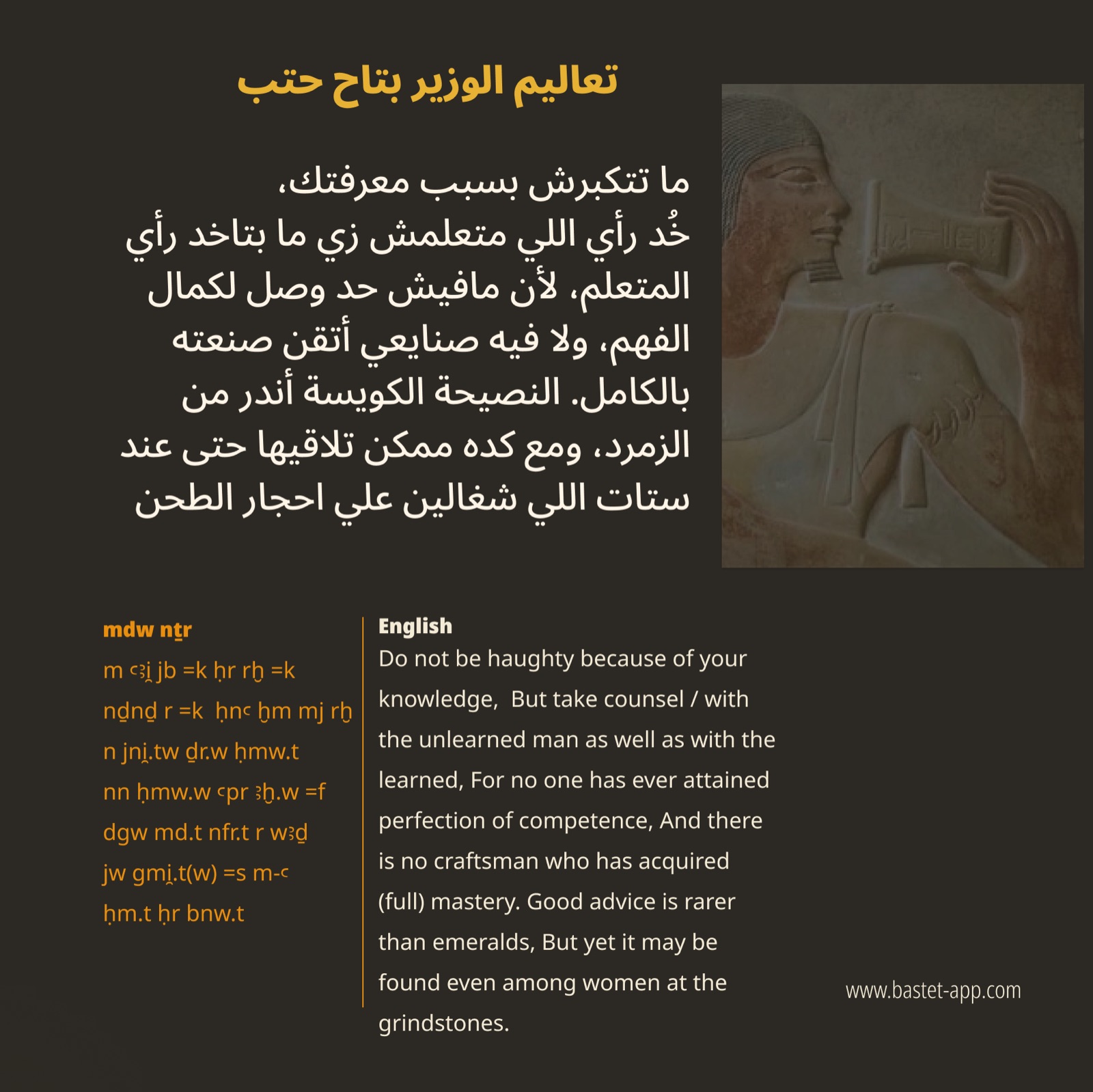
This article was written in Arabic; the text below is an English rendering of the author's Egyptian Arabic translation of the ancient text.
Prologue
The Instruction of the mayor of the city and vizier Ptahhotep, under the Majesty of the King of Upper and Lower Egypt, Isesi, who lives forever.
The mayor of the city, the vizier Ptahhotep, said:
My lord, my sovereign,
Age has grown heavy, illness has come down on me, weariness is drawing near, and weakness keeps growing.
A man now has to take a nap every day, like a little child.
The eyes have turned hazy, the ears hear nothing,
and strength drains away from sheer exhaustion.
The mouth is silent and no longer speaks,
the memory is gone, and I can't even remember yesterday.
The bones ache from weakness,
pleasure weighs heavy on the soul, and every taste is gone.
Old age does something truly wretched to people.
The nose is blocked and you cannot breathe,
and even standing up and sitting down have become exhausting.Allow your humble servant to appoint someone to help him in his old age,
and allow my son to take my place after me.
So I will teach him the rulings of the judges and the wisdom of those who lived in times past,
those who listened to the words of the gods.
Then the same will be done for you as was done before;
strife will vanish from among the people,
and the two banks of the river will serve you.
Then His Majesty the god said:
Before you retire, teach him what was said in the past.
After that he will be a model for the sons of the nobles, once he is filled with understanding and precision.
Teach him, for no one is born wise.
The Maxims
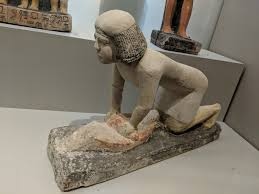
1) Do not be proud of your knowledge. Seek the opinion of the unlearned just as you seek that of the learned, because no one has ever reached perfect understanding, and there is no craftsman who has mastered his craft a hundred percent. Good advice is rarer than emerald, and yet you may find it even among the women who work at the grindstones.
2) If you face a hostile opponent (in court) who has more influence and distinction than you, lower your arms and bow. If you stand up against him, he will not give way to you. Make light of his hostile words; do not oppose him in the heat of his anger. The result will be that he is branded as rude, and your self-control will match his chatter.
3) If you face a hostile opponent who is your equal, of the same social standing, you will prove yourself more upright than he is by keeping silent, while he speaks out of a desire for revenge. The judges' deliberation of the matter will be serious and solemn, but your name will be cleared and vindicated in the verdict of the judges and the rulers.
4) And if you stand before a hostile opponent who is below you in rank and not your equal, do not stoop to his level and do not attack him just because he is weak.
Leave him as he is, and he will ruin himself. Do not answer him to vent your spite, and do not pour out your anger at his expense.
Wretched is the man who oppresses someone weaker than himself. In the end things will go your way, and you will defeat him through the judges' blame and verdict.
5) If you are a ruler responsible for the affairs of the people, look for every opportunity to do good,
so that there is no flaw in your deeds.
Great is Maat, and her foundation is firm;
she has not been shaken since the time of Osiris,
and whoever breaks the laws must be punished.
The greedy man does not see that wealth may be lost through fraud,
and that injustice does not lead to success.
He says: "I will get wealth for myself,"
and does not say: "I will get wealth through my own effort."
But in the end, it is Maat that remains,
and the honest man may say: "This is my inheritance."
Translator's note: Maat is the set of laws on which the judicial system of ancient Egypt was built, both in this life and in the judgment after death. It took the form of negative confessions recited by the deceased before the court of Osiris, such as: I did not steal, I did not kill, I was not arrogant toward people, I did not muddy the water of the river... and so on.
6) Do not inspire fear in people, or God will punish you in the same way. A man may decide to live like that, but in the end he will be deprived of his daily bread. A man may decide to become rich, and say: "I will seize everything I see." A man may decide to deceive others, but he will end up handing (his gains) to a complete stranger. It is not what people plan that happens, but what the Lord decrees. So live content, and let what they give come of its own accord.
10) If you are humble and the servant of a wealthy man, let all your conduct be faultless before God. And if you know that he was poor in the past, do not despise him merely because you know his past. Respect him for what he has made of himself, for wealth does not come of its own accord; it is a reward from God to the one with whom He is pleased. As for his possessions, he gathered them himself, but it is God who made him respected, and He protects him even in his sleep.
11) Follow your heart as long as you live. Do not work beyond what is asked of you. Do not waste the time of following your heart, because wasting it harms the soul. Do not squander the hours of the day except on what is necessary to manage your household. And when wealth has been gathered, follow your heart, for wealth is of no use if it is a burden.
Translator's note: The ancient Egyptians believed that the heart was the center of thought and feeling together. "Following the heart" means following your desires insofar as they accord with the moral law of Maat. It shows that the laws of Maat spring from within the human heart and are not foreign to it.
14) If you are among people, win for yourself trustworthy supporters.
The trustworthy man is the one who does not spread talk among people;
he himself will become a man of rank and a man of means, thanks to his good performance.
As for your good reputation, do not talk about it yourself.
Take care of your body, but direct your attention to people, and people will praise you without your noticing or knowing it.
As for the man whose heart obeys his stomach, he brings contempt upon himself instead of respect.
His heart is gloomy and his body wretched.
Those with great hearts are the ones the god has raised up, but whoever listens to his stomach is his own worst enemy.
17) If you are in authority, be patient when listening to your petitioner,
and do not dismiss him until he has told you everything he wanted to say.
The wronged man wants to express his distress and frustration
more than he wants the justice he came for.
As for the one who rejects petitions and pushes their owners away, people say of him: "Why did he refuse it in the first place?"
Not everything presented in a complaint will be carried out, but good listening and sympathy are a means of calming the heart and soothing it.
19) If you want your life to be free of blame, stay away from every evil.
Beware of the baseness of greed, for it is a dangerous affliction and an incurable disease; whoever falls into it has no cure.
It stirs up strife between fathers, mothers and maternal brothers,
it corrupts the feelings of loved ones, it drives the faithful man away from his master, and it separates a wife from her husband.
It is a container of every evil and a mixture of everything hateful.
But the man who perfects uprightness and walks in accordance with his station will endure and will make his memory last, while the greedy will have no tomb.
20) Do not be selfish over an inheritance, and do not covet more than your share.
And do not be selfish with your relatives, because the right of the gentle person is greater than that of the one who shouts and demands loudly.
He who abandons his relatives is truly poor, because he lacks the mercy that would make him respond to their requests.
Even a little of what a person craves can calm someone who is distressed.
22) Delight your friends with what God has given you, for what the Lord has given you is a blessing from Him. As for the one who does not delight his friends, people will say he is selfish. No one knows what will happen tomorrow, and the good man is the one through whom people are provided for. If a man does praiseworthy deeds, his friends say to him: Well done! A man cannot please a whole city, but he can make his friends happy when they are in need.
23) Do not repeat slander, and do not listen to it; it is all empty talk from someone ill-mannered.
Say only what you saw with your own eyes, not what you heard, or else forget it completely and say nothing,
because whoever hears you knows how to tell what is believable and what is not.
When taxes are imposed and enforced, people hate the collector just as they hate the decree itself.
Slander is like a nightmare; stay away from it and cut your ties with it.
24) If you are a man trusted by those who sit in their lord's council, direct your attention to excellence.
Your silence is more useful to you than too much talk, so do not speak unless you know you are qualified to.
Speaking in the council is fitting only for those who have mastered it,
for speech is harder than any craft, and only the capable and competent can give it dignity and authority.
Translator's note: "Their lord" in the text refers to the king of Egypt.
25) If you are a man of influence, you should establish others' respect for you through knowledge and tact in speech. Do not be domineering except in official matters, for the aggressive man meets with trouble. Do not be arrogant, lest you be humiliated, and do not be silent, but beware of giving offense when you answer in anger.
Turn your face away and take control of yourself, for the fires of anger spread quickly, while the amiable person takes care when he is insulted. Whoever is stern all day long will never have a happy moment, and whoever is reckless all day long will never establish a household for himself.
The one who strives for absolute control is like the man holding the steering oar as he comes into harbor,
but in the end someone else is the one who ties up the boat.
But whoever obeys his heart keeps order.
27) Report to the official what benefits him, and make people accept him.
Let his wisdom be known to his lord, and then plenty of good will come to you from his generosity.
The man of good character is good for you, because he is a protection for you.
And his satisfaction will be a support for your household,
under your generous lord, to whom you are loyal.
Support him in this way, and he in turn will give you strong support.
And affection for you will also remain steady in the hearts of those who value you.
See, the one who listens well is honored and his standing is high.
28) If you find yourself working as a senior official at court, appointed to decide disputes between people,
cultivate impartiality within yourself.
And when you speak, do not lean toward one party over the other.
Take care that no one stands up before the judges and says:
"This man twists the case to suit his own whim." Then your conduct will become a charge against you.
34) Be generous as long as you live, for what leaves the storehouse does not return to it, and people long for bread that is given freely. The one who is hungry is an accuser, and such an opponent becomes a bringer of ill omen; do not take him as a friend. Kindness is a monument to a man for all the years that follow his taking office.
Epilogue
39) Listening is beneficial to the son who wants to listen, when what is heard takes root inside him;
the one who has listened becomes himself worthy of being listened to.
It is good for a man to listen, and it is good for him to speak,
but the one who knows how to listen is the one who profits. Listening benefits the listener,
and listening is better than anything else, because from it good affection is born.
How good it is for a son to accept his father's word, for in this way old age will come to him while he is steady.
The one who listens, the Lord is pleased with him, and the one with whom the Lord is angry does not listen.
It is the heart that makes its owner either listen or not listen.
A man's life, his welfare and his health are all in his heart.
The one who listens is the one who concentrates on what is said, and the one who is ready to listen
is the one who carries out what he has been told.
How good it is when a son listens to his father's word, and how happy is
the one of whom it is said: "My son is pleasing, because he knows how to obey."
As for the one who listens to what is said to him,
he will be self-reliant and respected by his father.
And people will always remember him, both those who live now and those who are yet to come.
40) If the honorable man takes his father's words and sets them in his heart, not one of his endeavors will fail.
Teach your son to be a good listener, one who is held in esteem in the hearts of the nobles,
who shapes his speech according to what was said to him, and recognizes whom one must obey.
That is the son who will excel, and whose deeds will be distinguished.
But error is rooted in the one who does not listen.
The upbringing of the wise leads him to success, while the fool toils in vain.
41) As for the fool who does not listen, he will never accomplish anything.
He sees knowledge in ignorance, and sees benefit in what is harmful.
He does everything that repels, until people grow angry with him day after day.
He lives on what others die for, and lying speech is his food and drink.
His nature is known to those in authority, the image of a dead man who is alive, day after day.
And people turn a blind eye to his foolish deeds,
because of the many calamities that fall on him every day.
43) Do not say something and then take it back, and do not put one thing in the place of another.
Take care not to let yourself go and lose your temper; leave room for the words of the wise, and listen well.
If you want to be sure of the effect of your words on the people who hear you,
first become an expert, and then you will know how to speak correctly and with complete success, and everything you do will be right.
44) Restrain yourself and control your tongue, and then your advice will be accepted by the officials.
Be perfectly precise with your lord, and act so that people say of him: "He is the son of so-and-so,"
and those who hear say: "Blessed is the one who fathered him."
Be precise in your speech, so that you say only what is of importance.
Then the officials who listen will say: "How great his words are!"
45) Act in such a way that your lord says of you:
"He was raised in the best possible way at the hands of his father, who begot him from his own loins.
Surely he used to speak to him while he was still in his mother's womb, for what he achieved is greater than what he was told."
Mind you, the good son whom God grants is the one who goes beyond what his lord told him.
He is the one who acts with Maat, because his heart is the one that governs his conduct.
And now you are taking my place, with your body sound and your health good,
and the King pleased with everything that has happened. May you live for many long years.
What I have done on earth is not small: I lived one hundred and ten years, granted to me by the King,
and I received more honors than those who came before me.
And all this happened because I did justice for the King until I reached the state of veneration.
This was copied from beginning to end
exactly as it was written.