m, jm and mj in Ancient Egyptian: Meanings and Pronunciation
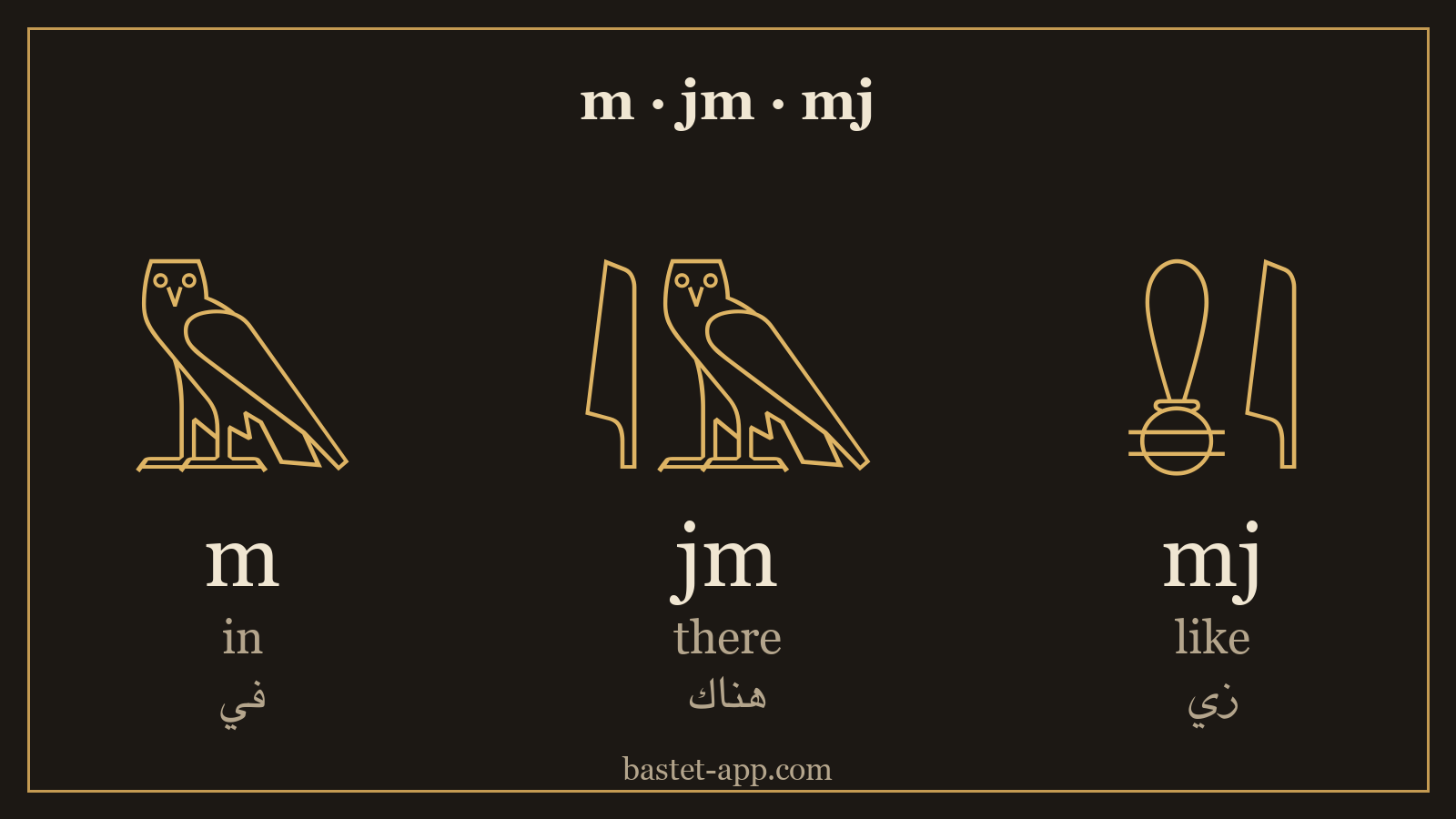
Once you start reading Egyptian texts, you will meet the owl 𓅓 in almost every line. Sometimes it stands alone (m), sometimes a reed leaf comes before it (jm), and sometimes the word is spelled with the milk jug 𓏇𓇋 (mj). The trouble is that each of these shapes can be more than one word: "in", "what?", "don't", "there", "come!", "like"… and each has its own pronunciation.
This article puts all of them in one place: hieroglyphs, transliteration, meaning and pronunciation. The pronunciations are written exactly as in the Bastet course, the same way as in the Bastet Dictionary.
How to read the pronunciation column
- A dot · separates syllables: a·maf is "a" then "maf".
- The bold, underlined syllable carries the stress.
- Vowels (a, i, u) are in gold; consonants are in white.
- A written j is pronounced as an "i/y" sound (mj~ = "mee"), and a written w as "w/u". We keep the written letter in the pronunciation so you can see what is actually written.
- ꜥ is the Arabic ʿayn, ḫ is the "ch" of Scottish loch, ẖ a softer "ch" (German ich), and ṯ is written with Arabic ث.
- A ~ after a pronunciation means its vowels are our best guess, just as in the course.
Where do the pronunciations come from? Mostly from James Allen's book on the sounds of Ancient Egyptian (Allen 2020) and from Coptic, the last stage of the Egyptian language, which was written in an alphabet with vowels.
1. m on its own 𓅓
The owl alone reads m. But the word changes with the sign written next to it:
| Word | Pronunciation | Meaning |
|---|---|---|
| m 𓅓 | im | in, with, from, as (preposition before a noun) |
| m 𓅓𓂝 | ma | what? (question word) |
| m 𓅓𓂜 | ma~ | don't …! (negative command before a verb) |
| m.k 𓅓𓂝𓎡 | mak | look!, here is (to a man) |
| m.ṯ / m.t 𓅓𓂝𓍿 | maṯ~ | look! (to a woman) |
m "in": why im and not ma?
The preposition m is the most frequent word in the language. In Coptic it became ⲙ̄- (a syllabic m, pronounced on its own), so we read it im: an m with a short vowel before it. Allen reconstructs the Middle Egyptian form before a noun as ma, but we chose im so that it never sounds like the m of "don't".
- 𓅓 𓊵𓏏𓊪 m ḥtp: im ḥa·tap "in peace, safely".
- 𓅓𓂝𓎡 𓇋𓂋𓆑 𓈖 𓇍𓇋𓂻𓈖𓏥 𓅓 𓊵𓏏𓊪 m.k r.f n jy.((n)) m ḥtp: mak raf nu jya·nu im ḥa·tap~ "Look at us, we have returned in peace" (from The Shipwrecked Sailor).
m "what?"
The same owl, but with the arm sign 𓂝. It is common in ḥr m "why?" (literally "on what?"). Allen prints its pronunciation as ma.
m "don't"
This one is written with the two outstretched arms 𓂜, the sign of negation. It comes before a verb: m grg "do not arrange". We read it ma~; that choice is ours (hence the ~), and what matters is that it does not sound like m "in".
m.k "look!"
This is m with the "you" pronoun: m.k to a man, m.ṯ to a woman, m.tn to several people. It opens a sentence to draw attention: 𓅓𓂝𓎡 𓄖𓂻𓈖𓈖𓏥 𓄚𓈖𓉐𓊖 m.k pḥ.n.n ẖnw mak piḥ·nin ẖnw "Look, we have reached home."
2. jm 𓇋𓅓: "there" and "in it / from it"
When a reed leaf 𓇋 stands before the owl, you are usually looking at jm. It has two big uses:
- jm on its own, at the end of a sentence, means "there".
- The preposition m becomes jm before a pronoun: you cannot say m.f, it has to be jm.f "in it / from it". Coptic did the same: ⲙ̄- before a noun, but ⲙⲙⲟϥ "in it" before a pronoun.
| Word | Pronunciation | Meaning |
|---|---|---|
| jm 𓇋𓅓 | a·mu~ | there |
| jm.j 𓇋𓅓𓀀 | a·maj~ | from me, in me |
| jm.k 𓇋𓅓𓎡 | jm·ak | from you, in you (to a man) |
| jm.f 𓇋𓅓𓆑 | a·maf~ | from it, in it (him) |
| jm.s 𓇋𓅓𓋴 | a·mas~ | from it, in it (her) |
| jmj 𓇋𓅓𓏭 | a·may~ | which is in…, belonging to (adjective from m) |
- 𓂋𓅓𓅱𓁿 𓇋𓅓 𓎛𓈖𓂝 𓄿𓊪𓂧𓅬𓅱 rm.w jm ḥnꜥ ꜣpd.w: rim·wu a·mu ḥi·naꜥ lap·dw~ "There were fish and birds there."
- 𓅱𓍑𓄿𓎡𓅱 𓂜𓈖 𓇋𓍿𓏏 𓇋𓅓𓀀 wḏꜣ.kw nn jṯj.t jm.j: wa·ḏa·kw nan j·ṯjt a·maj~ "I was fine, nothing was taken from me."
- 𓋴𓐪𓂧𓅱𓀀𓏥 𓍢𓎇 𓇋𓅓𓋴 𓅓 𓋴𓏏𓊪𓍉 𓈖 𓆎𓅓𓏏𓊖 sqd 120 jm.s m stp n(.j) Km.t: saq·daw 120 a·mas im sa·tap ni ki·mat~ "There were 120 sailors on it, some of the best in Egypt." Note jm.s and m in the same sentence: the first before a pronoun, the second before a noun.
jmj (with the two strokes 𓏭 at the end) is the adjective made from m: "which is in". It gives jmj-rꜣ "overseer" (literally "the one in the mouth", i.e. whose word is followed), and jmt for the feminine. Its Middle Egyptian pronunciation is not known exactly, hence the ~.
3. The verb jmj: "give!" and "do not"
Two more verbs look like jm in writing, and it helps to know them so you don't mix them up:
| Word | Pronunciation | Meaning |
|---|---|---|
| jmj 𓇋𓐛𓅓𓂝 | a·ma~ | give!, put! (imperative of "to give") |
| jm.f 𓇋𓅓𓂜𓆑 | jm·af | he does not / he should not (the negative verb jmj) |
| jm.k 𓇋𓅓𓂜𓎡 | jm·ak | you do not (you, a man) |
- 𓇋𓐛𓅓𓂝 𓈗 𓁷𓏤 𓂭𓂝𓅱𓅪𓏥𓎡 jmj mw ḥr ḏbꜥ.k: a·ma maw ḥir ḏu·ba·ꜥu·wik~ "Put water on your fingers!"
In writing, jm.f "in it" and jm.f "he does not" differ by the negation sign 𓂜; in speech, the first is a·maf~ and the second jm·af (Allen prints im-AF for the negative verb; we keep the written j, as the course does). The m "don't" from section 1 is the imperative of this same verb.
4. mj 𓏇𓇋: "like", "come!", "please"
The milk jug 𓏇 reads mj. Here too there are several words:
| Word | Pronunciation | Meaning |
|---|---|---|
| mj 𓏇𓇋 | mj~ | like, as (preposition of comparison) |
| mj 𓅓𓂝𓇋𓂻 | a·ma | come! (to a man) |
| mj 𓏇𓇋 | maj | now, please (after a command) |
| (j)n mj 𓇋𓈖 𓏇𓇋 | ma | who? / what? (question word, like m) |
| mjtt 𓏇𓏏𓏏 | mj·a·ta | the like, something similar |
| m-mjtt 𓅓 𓏇𓏏𓏏 | im mj·a·ta~ | likewise, also |
The best illustration is a sentence with mj twice, in two meanings and two pronunciations:
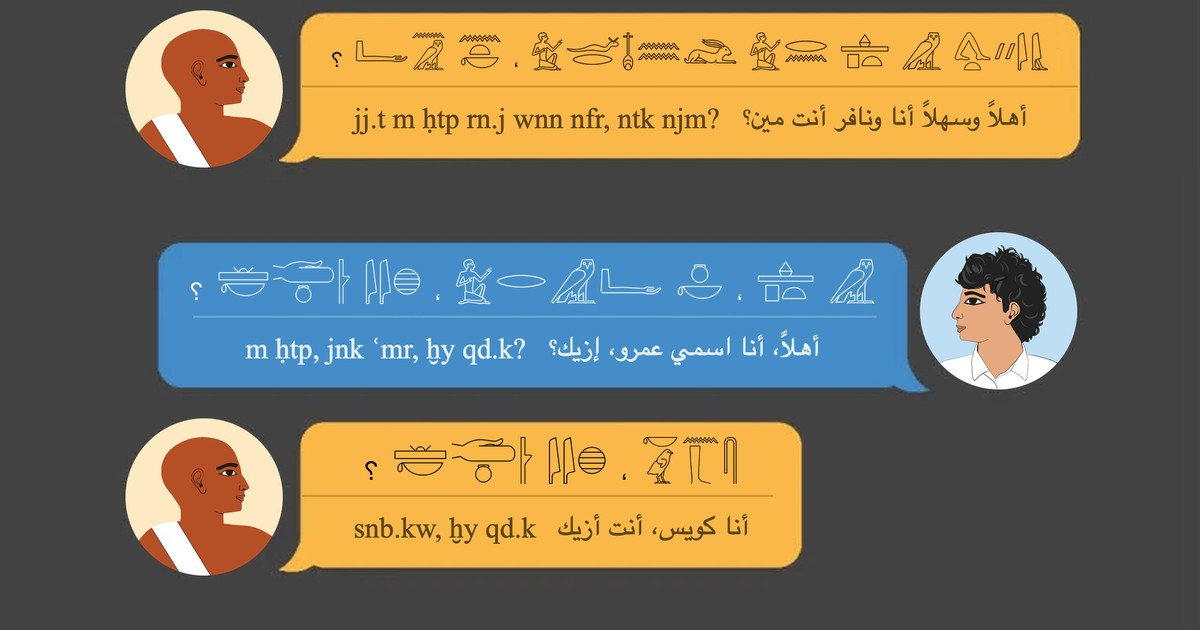
- 𓅓𓂝𓇋𓂻 𓏇𓇋 𓂝𓅓𓂋𓀀 𓐍𓈖𓌱𓅓𓋴𓀙𓀀 mj mj ꜥmr ẖnms.j: a·ma maj ꜥam·ru ḫan·msj~ "Come in, Amr, my friend!" The first mj is "come!" (a·ma), the second "now, please" (maj).
- 𓏙 𓏇𓇋 𓈖𓀀 𓈗 dj mj n.j mw: dj·a maj nj maw "Please give me water."
- 𓂓𓄿𓅱𓆭𓏥 𓇋𓅓 𓎛𓈖𓂝 𓈖𓈎𓅱𓏏𓆭𓏥 𓋴𓈙𓊪𓏏𓆰𓏥 𓏇𓇋 𓁹𓏏𓅱𓋴 kꜣ.w jm ḥnꜥ nq.wt sšp.t mj jrj.t(w).s: ka·lw a·mu ḥi·naꜥ naq·wat saš·pat mj j·ra·tus~ "There were sycamore figs there, and cucumbers as if they had been grown." Here jm "there" and mj "like" sit in the same sentence.
Note that "come!" mj is pronounced a·ma, exactly like "give!" jmj. That is not a mistake: Coptic kept the a- at the start of "come!" (ⲁⲙⲟⲩ, amou), and Allen prints a-MA for Late Egyptian "give!".
5. Compounds that start with m
Many compound prepositions are built from m + a noun. Here the m stays im, except m-ꜥ "with", which we read ma·ꜥa~:
| Word | Pronunciation | Meaning |
|---|---|---|
| m-ꜥ.k 𓅓𓂝𓎡 | ma·ꜥak~ | in your hand, with you (literally "in your arm") |
| m-ꜥ.j 𓅓𓂝𓀀 | ma·ꜥaj~ | with me, to me |
| m-ḫt 𓅓𓆱𓐍𓏏𓂻 | im·ḫat~ | after |
| m-bꜣḥ.k 𓅓𓂺𓏛𓎡 | im·balḥk~ | in front of you |
| m-ẖnw.f 𓅓𓄚𓈖𓏌𓅱𓉐𓆑 | im·ẖnwf~ | inside it |
| m-qꜣb.sn 𓅓𓈎𓄿𓃀𓄲𓋴𓈖𓏥 | im·qab·sun~ | among them |
| m-ḥr-jb.sn 𓅓𓁷𓏤𓄣𓏤𓋴𓈖𓏥 | im·ḥir·jib·sun~ | among them, in their midst |
| m-hꜣw 𓅓𓉔𓄿𓅱𓏛𓏥 | im·ha·law~ | near, beside |
- 𓌃𓂧𓅱𓎡 𓈖 𓇓𓏏𓈖 𓄣𓏤𓎡 𓅓𓂝𓎡 mdwj.k n nswt jb.k m-ꜥ.k: mad·wak ni ni·swt ji·bik ma·ꜥak~ "Speak to the king with your heart in your hand", that is, speak boldly.
ma·ꜥak sounds close to Arabic «معاك» (maʿāk, "with you"), but the resemblance is only in the sound: the Egyptian word literally means "in the arm" (m + ꜥ).
Summary: telling them apart at a glance
| If you see | It is usually | Pronunciation |
|---|---|---|
| 𓅓 alone before a noun | "in, with, from" | im |
| 𓅓𓂜 before a verb | "don't" | ma~ |
| 𓅓𓂝 in a question | "what?" | ma |
| 𓅓𓂝𓎡 opening a sentence | "look!" | mak |
| 𓅓𓂝 + pronoun inside a sentence | "with you / in your hand" | ma·ꜥak~ |
| 𓇋𓅓 at the end of a sentence | "there" | a·mu~ |
| 𓇋𓅓 + pronoun | "in it / from it" | a·maf~, a·mas~… |
| 𓇋𓐛𓅓𓂝 | "give!, put!" | a·ma~ |
| 𓏇𓇋 before a noun | "like" | mj~ |
| 𓏇𓇋 after a command | "now, please" | maj |
| 𓅓𓂝𓇋𓂻 (with walking legs) | "come!" | a·ma |
The golden rule: m before a noun, jm before a pronoun. If you see the walking legs 𓂻, there is movement ("come!"); if you see the outstretched arms 𓂜, there is negation.
You can practise all of these words, and hear them pronounced, in the Bastet course.
Sources
- James P. Allen, Ancient Egyptian Phonology (2020), pp. 100–102 (m "what?", m.k, the negative verb), p. 106 (jm "there"), pp. 135–136 and 171 (mj "come!", jmj "give!"), pp. 146–147 (mj "please"), pp. 172–174 (the prepositions m and mj).
- James P. Allen, Middle Egyptian: An Introduction to the Language and Culture of Hieroglyphs (2014), §§15.3, 16.8, 18.2.
- W. E. Crum, A Coptic Dictionary, pp. 215–216 (Coptic ⲙ̄- / ⲙⲙⲟ⸗).
- The Bastet pronunciation dictionary and the Bastet course.